|
|
|
|
|
|
|
|
|
Boots Boots have remained a constant requirement of the Canadian soldier throughout the 20th Century. First World War Canadian pattern boots issued early in the First World War were, like many items of Canadian dress in 1914, not equal to the rigours of service life. The soles of these early boots were prone to dissolving in wet conditions - and the first weeks spent on Salisbury Plain by the First Contingent were among the wettest in the history of the region. By 1916, the Canadian-made boots were relegated for issue to troops in training in the U.K. and replaced by British boots when troops were sent to the Continent. Ammunition Boots - the standard combat boot worn by Canadians was the Ammunition Boot. These were black leather ankle-high boots, of pebbled leather with a prominent toe cap. All troops were also issued canvas shoes for wear off-duty. "Larrigan" boots, a type of waterproof footwear common in Canada, was a popular footgear in the trenches. Mounted officers by regulation wore laced brown leather ankle boots, or regulation "field boots" or "Strathcona boots." Dismounted officers were directed to wear brown leather ankle boots.1 Ankle length boots were invariably worn with ankle-length puttees of khaki material matching the service dress uniform; mounted troops wrapped the puttees from the knee down to the ankle, and foot soldiers wrapped the puttees from the ankle to the top of the calf. Second World War During the Second World War, many different patterns of boots were issued. Ammunition Boots The standard Ammunition Boot, as it came to be manufactured by Canadian suppliers, was very similar to the British pattern, though Canadian boots lacked the toe cap. Officer's boots were made of brown leather and worn according to dress regulations; in general armoured corps officers and officers of rifle and highland regiments wore black boots.
Despatch Riders High top boots issued to motorcycle messengers.
AFV Crews Rubber-soled ankle boots were issued to crews of armoured vehicles. Jump Boots At various times in the history of Canadian parachute troops, high-ankled boots or 'jump boots' were issued.
Postwar In Korea, a variety of boots were worn by Canadians, including foreign issued items.
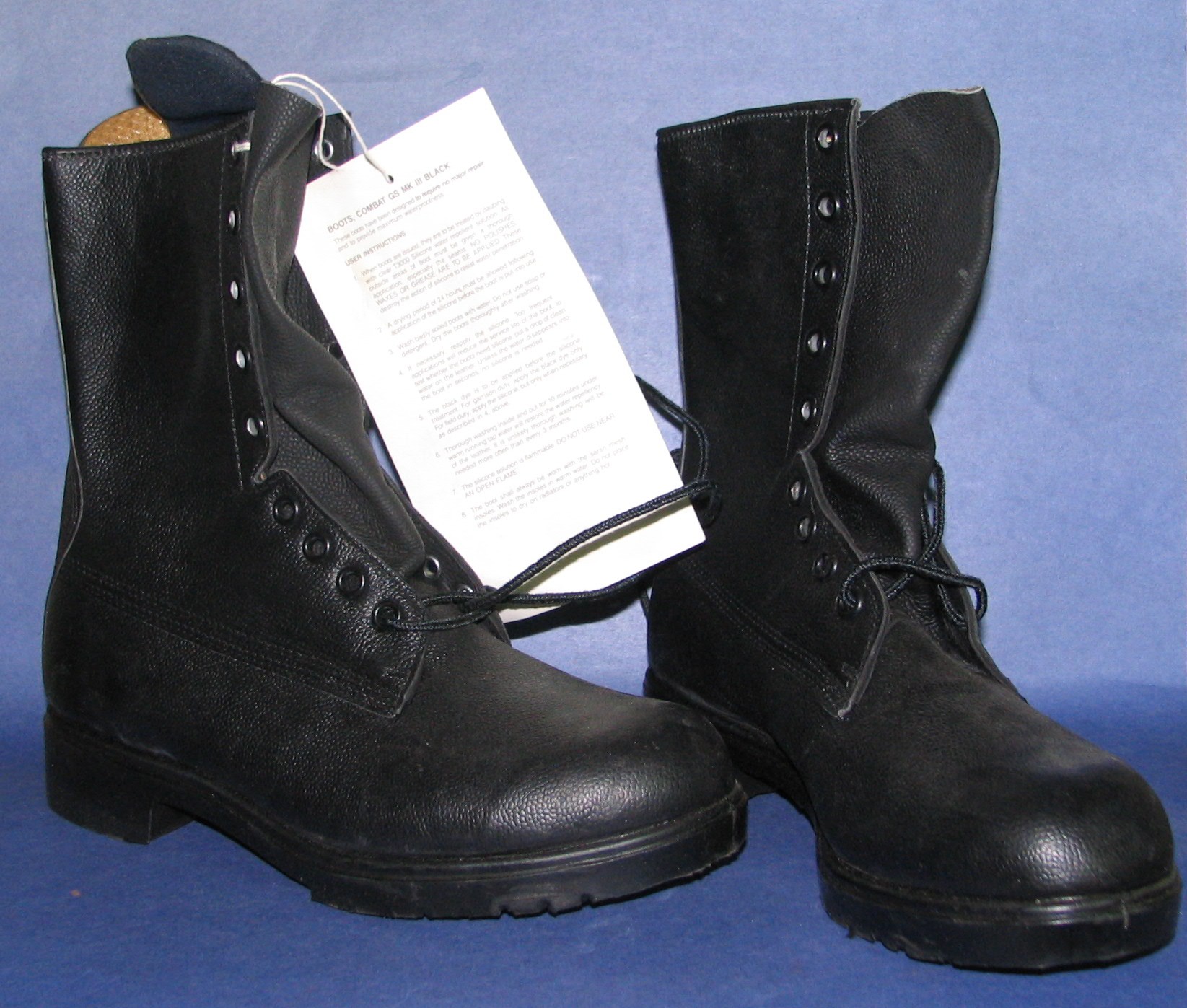
Combat Boots The Canadian Army adopted a rubber soled combat boot very similar to the 3rd Division Boots, though without the buckle and cuff. Three separate marks were produced. The early marks had a pronounced welt on the sole. Boot care was officially to be done with special preservative issued in metal tins rather than boot polish; in practice this was not often the reality. The combat boot was worn with Work Dress as well as the combat uniform, and continued in use with the new CADPAT uniforms also.
Parade Boots Parade Boots (also known as Ankle Boots) were a stiffer, more formal style of boot very similar in appearance to the Ammunition Boot. They came to be worn as part of working, walking out, and parade dress. SSF Boots The SSF Boot or "Jump Boot" was a privilege extended to parachute qualified personnel, who wore the boots not only with field gear but also when in dress uniform. Garrison Dress Boots A high top boot with smooth leather issued with Garrison Dress.
Cold and Wet Weather Boots A variety of cold and wet weather boots were also issued for muddy and snowy conditions.
|
|||||||||||||||||||||||||||||||||||